
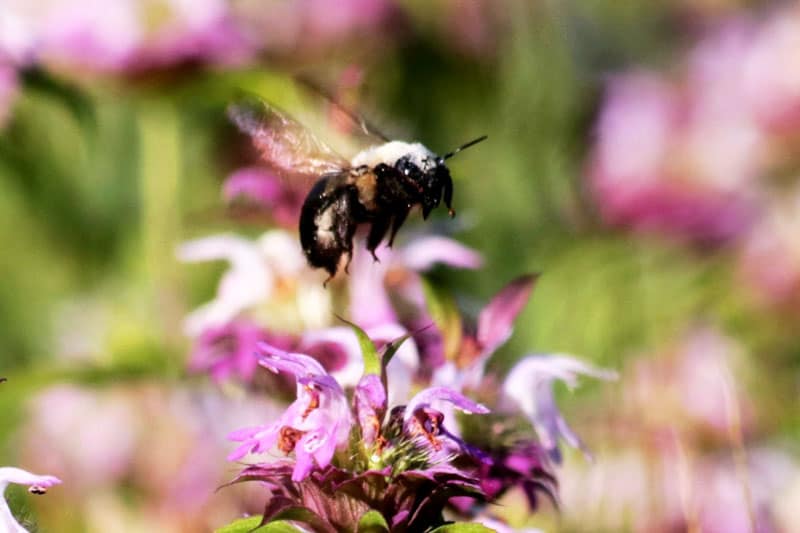
Every spring, homeowners across North America step out onto their porches only to be greeted by an unnerving sight: a heavy, black-and-yellow insect hovering suspended in mid-air, eyeballing them from two feet away. Within seconds, it darts forward in an erratic dive-bomb, buzzing like a miniature engine before settling directly beneath a cedar railing.
For anyone who has invested thousands of dollars in an outdoor deck, pergola, or cedar trim, the initial reaction is usually panic. These robust flyers are carpenter bees, and few insects manage to occupy such a deeply contradictory space in our yards. To an organic gardener, they are powerhouses of native pollination, dutifully working fruit blossoms when honeybees are still huddled in their hives. To a homeowner holding a drill-straight pile of sawdust, they look like airborne termites with an appetite for outdoor real estate.
Untangling whether these insects are gentle backyard allies or structural saboteurs requires understanding their biology, their nesting habits, and the realistic threat they pose to structural lumber.
Identifying the Carpenter Bee: Bumblebee Lookalike with a Telltale Sign
At a quick glance, most people mistake carpenter bees for bumblebees. Both insects share a similar bulky frame and loud, low-frequency hum, but a closer look reveals obvious physical and behavioral distinctions.
The easiest way to tell the two apart is by looking at the abdomen. A bumblebee has a soft, fuzzy, matte-yellow or black rear covered in fine hair. A carpenter bee, by contrast, sports a bare, shiny, metallic black or deep purplish abdomen that glints in direct sunlight.
Their social structure is also completely different. Bumblebees are social creatures living in communal colonies, often nesting underground in old rodent burrows. Carpenter bees are solitary nesters. They do not build shared hives, produce commercially harvestable honey, or serve a central queen. Instead, individual mated pairs operate on their own, finding secluded pieces of timber to construct small personal nurseries for their young.
Homeowners also frequently misunderstand their aggression. The bees that spend their afternoons hovering aggressively near eye level, chasing away songbirds, pets, and humans, are almost always males defending their territory. Despite their menacing posturing, male carpenter bees possess no stinger. Their bluster is entirely theatrical. The females do possess a functional stinger, but they are remarkably docile, spending their days gathering nectar and excavating wood. A female carpenter bee will generally sting only if she is physically pinched, stepped on, or trapped against bare skin.
The Ecological Asset: Why Gardens Rely on Them
Before reaching for an aerosol can of industrial insecticide, it helps to understand why entomologists defend carpenter bees so fiercely. These are native North American pollinators that evolved alongside indigenous plants long before European honeybees were brought to the continent.
Carpenter bees excel at an advanced foraging technique known as buzz pollination, or sonication. Certain plants, particularly members of the nightshade family like tomatoes, peppers, and eggplants, hold their pollen tightly within narrow, tubular anthers. Ordinary honeybees cannot shake this pollen loose efficiently. A carpenter bee lands on the flower, decouples its flight wings, and flexes its powerful thoracic muscles to create an intense acoustic vibration. This frequency causes the flower to explode with pollen, coating the bee and ensuring exceptionally high fruit-set rates for vegetable gardens and berry patches.
They are also among the earliest pollinators to emerge in the spring, remaining active at cooler temperatures and lower light levels than imported honeybees. From flowering native trees to backyard blueberry bushes, carpenter bees play an irreplaceable role in keeping neighborhood ecosystems productive. Eliminating them from an entire property often leads to visibly diminished yields in nearby vegetable gardens and flower beds.
The Architectural Threat: How Wood Boring Actually Works
While their floral resume is pristine, their residential construction habits present a genuine dilemma. The common misconception is that carpenter bees eat wood. They do not consume cellulose like termites or powderpost beetles. Instead, they use their formidable mandibles to scrape and carve structural wood, discarding the shavings as a coarse, sawdust-like powder known as frass.
A female carpenter bee selects an entry point, typically on the underside or backside of an exposed wooden board to protect the opening from driving rain. She uses her jaws to rasp a nearly perfect, circular hole roughly half an inch in diameter—so symmetrical that it looks as though someone bored into the lumber with a brand-new Forstner bit.
Once she cuts into the wood across the grain to a depth of about an inch, she makes a sharp, ninety-degree turn, tunneling parallel to the grain of the wood. Within this horizontal gallery, she carves out six to eight individual brood cells. In each cell, she deposits a small ball of “bee bread”—a dense mixture of regurgitated nectar and pollen—lays a single egg, and seals the chamber with a glued partition made from compacted wood pulp.
Carpenter bees show a strong preference for softwoods with low moisture content and straight grain. Untreated cedar, redwood, cypress, and unpainted pine are their prime targets. You will commonly find their entry holes along the edges of roof eaves, fascia boards, porch ceilings, window headers, and the underside of deck steps and railings.
The Cumulative Damage: When One Hole Turns into Real Trouble
If carpenter bees drilled a single, half-inch hole and vanished forever, they would be an aesthetic nuisance at worst. Structural lumber is engineered to carry significant loads, and an isolated tunnel rarely threatens the safety of a porch or pergola. The real danger comes from their long-term fidelity to the exact same nesting sites.
Carpenter bee offspring pupate inside their wooden chambers and emerge as adults in late summer, feeding on nectar to build reserves before overwintering inside the protective tunnels. Come spring, new females frequently choose to expand the existing galleries rather than spend valuable energy carving fresh ones from scratch.
Generation after generation, these internal networks grow. What started as a modest four-inch gallery can stretch to several feet over three or four seasons. When multiple females nest in the same rafter or rim joist, the interior of the timber is slowly hollowed out into a honeycomb pattern. The wood retains its outer appearance, but its structural integrity degrades significantly, increasing the risk of mechanical failure under heavy weight or snow loads.
Furthermore, open boreholes create pathways for moisture. Rainwater driven by spring wind enters the tunnels, where it cannot easily drain or evaporate. Over time, this stagnant moisture breeds fungal wood rot, accelerating decay deep within joists where visual inspection is difficult.
Then comes the secondary, often far more catastrophic threat: woodpeckers. Birds like the pileated woodpecker and hairy woodpecker can hear carpenter bee larvae wriggling inside the wood. To reach these fat, protein-rich grubs, a woodpecker will mercilessly hack into the timber with its chisel-like beak, turning a subtle half-inch drill hole into a ragged, eight-inch trench in an afternoon. In many cases, the bird does ten times more structural damage than the bee ever did.
Practical Strategies to Protect Your Deck
Living peacefully alongside native pollinators while safeguarding your home requires an integrated, defensive strategy. Relying on heavy, broadcast pesticide sprays is rarely effective; adult bees spend little time resting on treated surfaces, and topical chemicals will wipe out dozens of other beneficial insects along the way. Instead, target their nesting instincts directly.
Seal and Coat Exposed Timber
Carpenter bees are instinctually drawn to weathered, bare lumber that emits the natural scent of wood fibers. They struggle with surfaces that are slick, heavily sealed, or coated.
-
Paint your trim and railings. A thick, high-quality exterior acrylic or oil-based paint offers the strongest defense. Paint seals the scent of raw wood and creates a synthetic barrier that females avoid. Stains offer some protection, but solid-color stains perform vastly better than transparent oil finishes.
-
Inspect the undersides. Homeowners often paint the top surfaces of deck boards and railings for aesthetic reasons but leave the undersides raw. Carpenter bees instinctively search for these unpainted underbellies. Coat every exposed face, edge, and butt-end of exterior softwoods.
-
Consider synthetic alternatives. If you are designing a new deck or replacing damaged railings, consider composite decking materials, cellular PVC trim, or naturally dense hardwoods like ipe. Carpenter bees cannot chew through synthetic composites and generally bypass dense, resinous hardwoods in favor of softer pine.
Address Existing Galleries Promptly
Leaving old holes unsealed invites a cycle of reinfestation year after year. However, plugging an active hole incorrectly can trap angry females inside, prompting them to chew new exit routes directly through adjacent walls, siding, or drywall.
Wait until late summer or early fall when all the larvae have matured and emerged, or treat the interior of the hole with an insecticidal dust formulated for wood-boring insects. Give the treatment a few days to work, then permanently plug the opening.
Do not rely on silicone caulk alone, as determined bees can chew straight through it. Instead, coat a half-inch wooden dowel in weatherproof wood glue, drive it flush into the hole, and chisel off the excess. Alternatively, pack the hole tightly with coarse steel wool or copper mesh before topping it with exterior wood filler, sanding it smooth, and painting over the repair.
Deploy Mechanical Traps and Natural Repellents
If carpenter bees have already established your home as a mating ground, mechanical diversion can break the cycle without contaminating your soil or garden.
Carpenter bee traps—simple wooden boxes fitted with angled entry holes that empty into a clear plastic jar—rely on the bee’s attraction to existing dark tunnels and its instinct to fly toward light when trying to escape. Placed along sunny eaves and rooflines in early spring, these traps can reduce local populations around living spaces without broadcasting poisons into the air.
For spot deterrence on high-value furniture or porch swings, essential oils offer a temporary shield. Citrus oil, almond oil, and tea tree oil contain natural compounds that carpenter bees find offensive. Mixing pure citrus or eucalyptus essential oil with water and spraying it on vulnerable unpainted areas every few weeks during the peak spring excavation window can encourage exploratory females to nest elsewhere.
Provide a Dedicated Alternative
If you have a large yard and want to support local agriculture without sacrificing your deck, consider building an alternative habitat far away from your living structures. Mount a few untreated, weathered pine or cedar logs on a fence post at the sunny back perimeter of your property, well away from the house. Giving carpenter bees an easy, unobstructed piece of natural timber to colonize lets you enjoy their pollination services in the vegetable garden while keeping your architectural investments entirely out of the equation.
Striking the Right Balance
Carpenter bees are neither innocent, harmless bugs that you can safely ignore, nor malicious monsters determined to flatten your house overnight. They are native insects simply doing what their biology demands, caught in an awkward overlap between suburban architecture and natural ecology.
Ignoring a growing infestation under your deck railings is an expensive gamble that invites rot and woodpecker damage. Yet resorting to indiscriminate chemical warfare robs your yard of one of its most productive pollinators. By proactively sealing exposed wood, repairing old galleries, and steering these gentle flyers toward safe territory, you can maintain a sturdy, beautiful deck while still giving native nature room to thrive.
Meta Title: Carpenter Bees: Harmless Pollinators or Deck Destroyers?
Meta Description: Learn how carpenter bees impact your home, the structural risks of their nesting habits, and practical ways to protect your deck while preserving native pollinators.